ADVERTISEMENT
“It was scary at first,” Karapetyan recalled. “It was so loud, as if a bomb went off.”
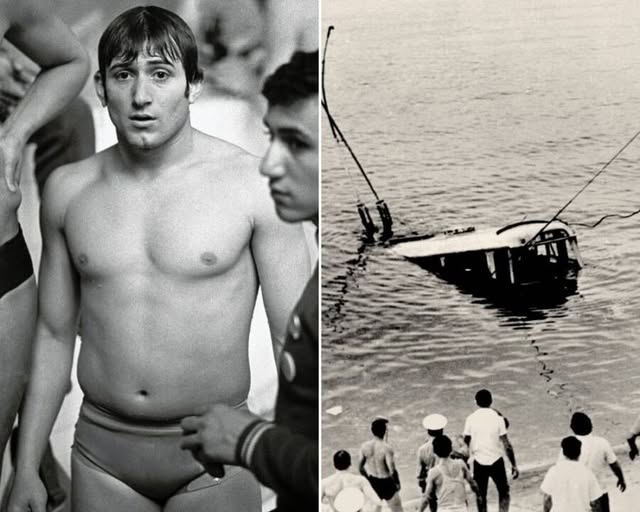
But at that moment, instinct took over. Shavarsh Karapetyan ran to the lake, took a deep breath, and jumped in. He swam fifteen feet below the surface and kicked open a window with his left leg. Blinded by the swirling silt, he reached inside and grabbed for any survivors.
He dove again and again, 40 times, bringing up as many people as he could. After handing them off to his brother, who was also a champion swimmer and stayed on the surface to ferry people to shore, Karapetyan went back underwater.
“I didn’t see the person who saved me because he held me from behind when he dragged me up,” one 17-year-old survivor said. “But I remember his hand well — a strong, muscular hand. I could feel I was being pulled somewhere, and then I blacked out again.”
“I had nightmares about that cushion for a long time,” Karapetyan said. “I could have saved someone else’s life.”
Karapetyan bandaged the lacerations on his leg and went home. But that evening, his temperature spiked, and he began to have convulsions. A physician and family friend took him to the hospital, where he spent several heartstopping days in critical care.
Yet, it took years for the Soviet Union to fully recognize what he had done.
“Immediately after the accident, some people wanted to publish an article in a newspaper, but this was not allowed,” Karapetyan explained. “In the USSR, trolleybuses were not supposed to fall into the water.”
“It wasn’t that I was scared of the water,” he said. “I just hated it.”
Nevertheless, he competed a handful more times. Karapetyan set a world record in the 400-meter event at the USSR championship and later won gold and bronze medals at the European championship in Hungary. After that, Karapetyan hung up his fins for good.
But his heroism in Yerevan remained unknown — until 1982. That year, a journalist heard about the trolleybus accident while covering a finswimming competition and wrote about it for the Moscow newspaper Komsomolskaya Pravda. Though the article made no mention of the trolleybus fatalities, it did highlight Karapetyan’s heroism.
Like that, Shavarsh Karapetyan became a hero. Soviet authorities awarded him the Order of the Badge of Honor, the Minor Planet Committee named an asteroid after him, and tens of thousands of Soviet citizens wrote him admiring letters.
Karapetyan could have rested on his laurels at that point. But in 1985, when Yerevan’s Sports and Concert Complex caught fire, he raced into the flames to save people — just as he had dove into the lake.
Continue reading…
