ADVERTISEMENT
Avery Grace Collins.
I had seen my mother holding me in a yellow blanket.
I had heard the story of my birth a hundred times, always the same version.
Whenever I asked about my father, her answer stayed short.
“He wasn’t ready to be a father.”
It became the quiet explanation behind every Father’s Day card I never made, every school form where Mom wrote her own name twice, every time I watched other girls run into their fathers’ arms after softball games.
I had accepted it.
Then I had grown around it like a tree growing around a fence.
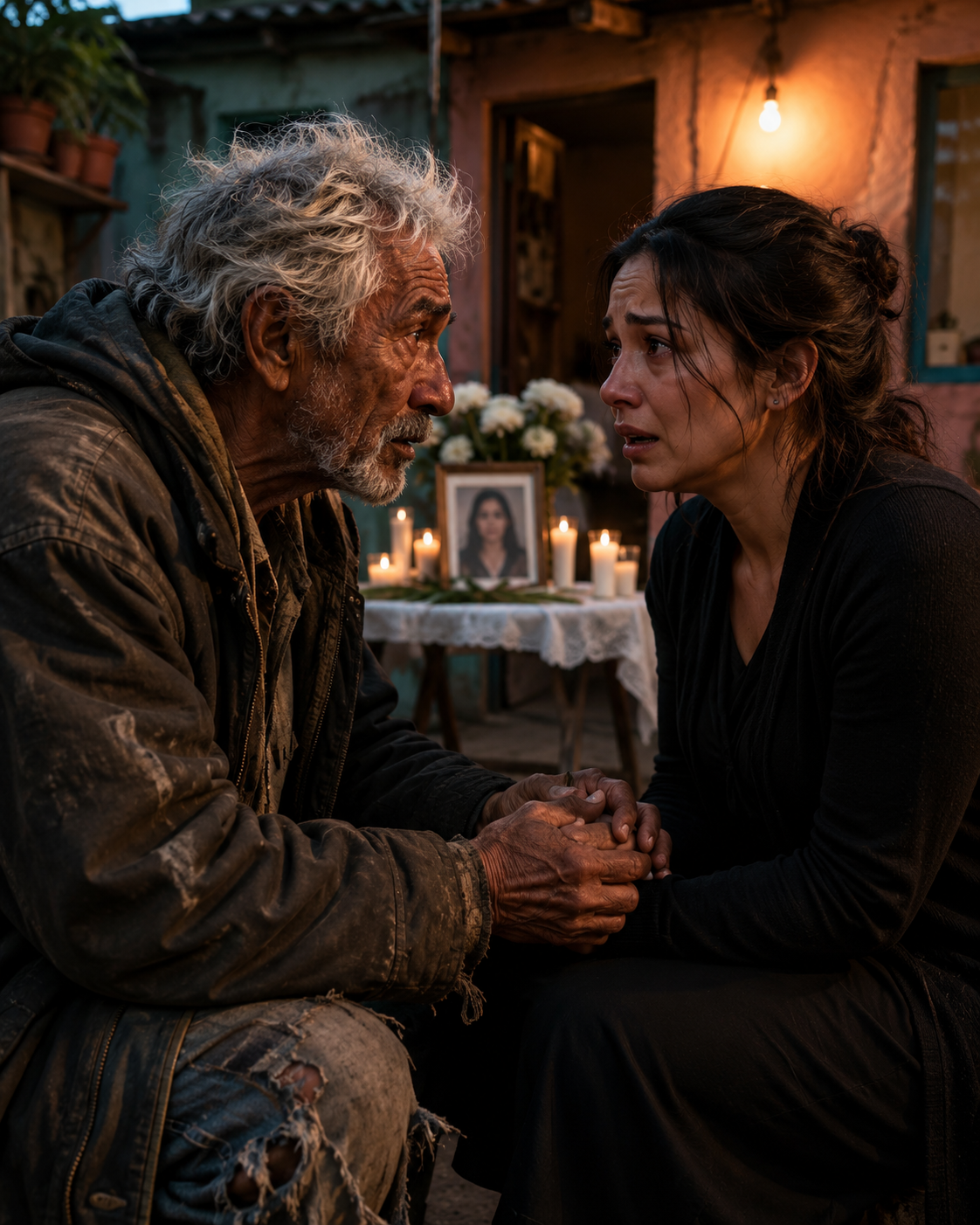
But now Walter Reeves sat across from me, the man I had stepped around in the alley for most of my childhood, and he was telling me the fence had never been where I thought it was.
My voice came out cold.
Walter nodded as if he had expected those words.
“My mother would have told me.”
“Then why didn’t she?”
He looked toward the kitchen stove, where one of Mom’s old pots still sat upside down on a towel.
“Because she was protecting you from a story that made adults look weak.”
I hated how gently he said it.
I wanted him to sound guilty.
I wanted him to sound like a villain.
It would have been easier.
Instead, he sounded like a man carrying a wound he had stopped asking anyone to heal.
I pushed the lunchbox away.
“No. You don’t get to walk in here the day after her funeral and rewrite my whole life.”
Walter flinched at the word “funeral,” but he did not defend himself.
“I know.”
“You were behind our house,” I said, my voice rising. “For thirty years. Do you understand how strange that is? I carried food to you. I was embarrassed because of you. People laughed at my mother because of you.”
His eyes filled.
“I know.”
“Stop saying that.”
He nodded.
I stood by the sink and gripped the counter.
Outside, the alley looked exactly the same. Cracked pavement. Rusty gate. The neighbor’s laundry line. Walter’s blue van parked beneath the sagging streetlight.
For years, I had thought that van represented my mother’s biggest weakness.
Her inability to stop giving.
Her refusal to let people face their own consequences.
But now I wondered if every dinner plate had been a language I never learned to translate.
Walter pulled a letter from the lunchbox.
“This is the one she told me to give you only if I couldn’t stay silent anymore.”
I turned around.
“Then why are you giving it to me?”
His hands tightened around the envelope.
“Because your aunt came to the alley this morning.”
“Aunt Diane?”
He nodded.
“She said the landlord wants you out in two weeks. She told me Grace had nothing, and I should stop hanging around because there would be no more free meals.”
I closed my eyes.
Of course Diane said that.
She had always measured people by what they owned, then called it realism.
Walter slid the envelope across the table.
“Your mother did not have nothing.”
I looked at him.
“What does that mean?”
“It means she was quiet, not empty.”
The envelope had my name written on it.
Avery, when you are ready.
My hands trembled when I opened it.
Inside were three pages.
The first line nearly broke me.
My sweet Avery,
If you are reading this, then Walter finally chose the truth over my fear. Don’t be angry with him first. Be angry with me if you need to. I was the one who asked him to stay silent.
I sat down slowly.
Walter looked away, giving me privacy in the only way he could.
I kept reading.
I met Walter Reeves when I was twenty. He was building cabinets in a restaurant where I worked double shifts. He made everyone laugh. He fixed things without being asked. He could turn a piece of broken wood into something beautiful, and I think that is why I loved him first.
I had never heard my mother talk like that.
Not about romance.
Not about wanting.
Not about a life before me.
To me, she had always been Mom: practical shoes, tired hands, grocery lists, church potlucks, clean laundry folded at midnight.
But here she was, young and alive on the page.
We planned to marry when I found out I was pregnant with you. Walter was terrified, but happy. He built a cradle before we could afford a crib. Then came the accident at the construction site.
I looked up.
Walter had bowed his head.
“What accident?”
He swallowed.
“A scaffold collapsed. Two men were badly hurt. I was the supervisor that day.”
I waited.
He continued, voice low.
“The company blamed me. I blamed myself too. There were investigations, lawyers, threats. I lost my job. I lost my license. I started sleeping in my truck because I didn’t want Grace pulled into it.”
“You could have called her.”
“I did.”
“And?”
“She begged me to come home.”
The answer surprised me.
“Then why didn’t you?”
Walter’s face twisted with old regret.
“Because I believed shame was noble if I carried it alone.”
That sentence landed hard.
I looked back at the letter.
Walter disappeared because he thought poverty and disgrace would follow him like smoke. I was young, proud, and hurt. When he finally came back, you were almost two. He looked thin. He looked lost. But he cried when he saw you through the window.
I remember him standing there, one hand on the fence, watching me hold you.
I wanted to open the door.
I wanted to scream at him.
I wanted to run into his arms.
Instead, I made him a plate.
That was how it began.
I pressed the paper against my chest.
My mother had not started feeding Walter because he was a stranger.
She fed him because she still saw the man beneath the ruin.
I kept reading.
I told him he could not come inside as your father unless he was ready to live as one. Not half-present. Not hiding. Not appearing and disappearing whenever shame got loud. I said you deserved steadiness.
He said he wasn’t steady yet.
So I told him the truth: I would never deny him food, but I would not let him break your heart by becoming a ghost with a title.
The words hurt, but they made sense in a way I wished they didn’t.
My mother had not kept him outside because she hated him.
She kept the boundary because she loved me.
Walter stayed nearby. At first I thought it was wrong. Then the nights got dangerous. He scared off a man trying to break into the laundry room. He fixed the back steps so you wouldn’t fall. He left cash in the mailbox when I was too proud to ask. He never once asked me to call him good.
I looked up sharply.
“Cash in the mailbox?”
Walter shook his head.
“Not much.”
“We were poor.”
“I know.”
“We ate soup with water in it.”
“I know.”
“Then why didn’t you help more?”
His eyes shone.
“Because every dollar I had came from day labor, scrap work, fixing fences, collecting cans, anything I could do. Most weeks, I had almost nothing. And your mother would not take money if she thought I needed it more.”
I believed that.
It sounded exactly like her.
I returned to the letter.
Avery, I know this will hurt. You may wonder why I let him stay so close but never told you who he was. The truth is ugly and simple: I was afraid.
I was afraid you would love him and lose him.
I was afraid you would hate him and become hard.
I was afraid relatives would turn his pain into gossip.
And maybe, most of all, I was afraid you would look at me differently for still caring about a man the world had thrown away.
I cried then.
Not the graceful kind.
The kind that bends your face into something you would never show a camera.
Because I finally understood the shape of my mother’s silence.
It was not one secret.
It was thirty years of choices made in the narrow space between compassion and protection.
Walter said nothing.
He let me cry.
That was the first fatherly thing he ever did.
He did not rush to comfort me so he could feel forgiven.
He did not ask if I understood.
He did not say, “I did my best.”
He just sat there with his rough hands folded, waiting beneath the weight of what he had not done.
When I finished the letter, there was one final paragraph.
If Walter gives you this, please know I asked him to keep quiet because I wanted your life to belong to you, not to our mistakes. But if the truth finds you anyway, don’t let it make you cruel.
Kindness is not foolishness, Avery.
But kindness without boundaries can become a cage.
I had to learn both.
I hope you do too.
Mom
For a long time, neither of us spoke.
Then Walter reached into the lunchbox again and pulled out a key.
“This is the other reason I came.”
I wiped my face.
“What is that?”
“A storage unit. Your mother kept things there. Papers. Photos. Some boxes.”
“I didn’t know she had a storage unit.”
“She didn’t want Diane to know.”
That made me laugh bitterly through my tears.
“She knew Diane well.”
Walter smiled faintly.
“She knew everyone.”
We went that afternoon.
I almost told him not to come.
Part of me still wanted distance.
But another part of me knew that if I waited, I might lose courage.
So Walter climbed into my rental car slowly, holding the lunchbox on his lap like a child holding a school project.
The storage place was fifteen minutes away, near an auto shop and a taco stand my mother used to love.
The unit smelled like cardboard, dust, and lavender soap.
Inside were plastic bins stacked neatly, each labeled in Mom’s handwriting.
Avery school
Christmas
Receipts
Walter
I stared at that last bin.
Walter did too.
“You open it,” he said.
I knelt and removed the lid.
Inside were photographs.
The first showed Walter as a young man, standing beside my mother in front of a diner. He had one arm around her shoulders. She looked shy and bright and impossibly young.
The second showed him holding a tiny baby.
Me.
I almost dropped it.
On the back, Mom had written:
Walter held her for eight minutes. He cried for seven.
I turned to him.
“You held me?”
His lips trembled.
“Once.”
“Why only once?”
“Because after that, your mother told me to decide. Either come in fully or stay out fully. I couldn’t trust myself to come in.”
“That was your decision?”
“Yes.”
“Not hers?”
His eyes met mine.
“Not hers.”
The honesty hurt.
But I needed it.
For years, my father had been an empty space I filled with imagination. Maybe he was cruel. Maybe he was rich. Maybe he had another family. Maybe he never thought of me at all.
Now he was real.
And real was messier.
He had loved me.
He had failed me.
Both could be true.
We spent three hours in the storage unit.
I found birthday cards Walter had written but never sent.
For Avery, age 5. You have your mother’s eyes.
For Avery, age 9. I saw your school play from the back door. You forgot one line and kept going. That was brave.
For Avery, age 16. I know you hate bringing dinner. I don’t blame you.
That one made me sit on the concrete floor.
I opened it carefully.
Dear Avery,
You looked angry tonight. You should be. Not because your mother feeds me. Because children should not have to carry adult mysteries through an alley.
I am sorry for being one of those mysteries.
I hope one day you know your mother is not weak. She is the strongest person I have ever known.
Walter
I covered my mouth.
All those years, I thought he didn’t notice my resentment.
He noticed everything.
He simply believed he had no right to answer it.
In another box, I found documents.
Not wealth.
Not some dramatic inheritance.
But something better than the fantasy I had secretly wanted.
Proof of a life my mother had built quietly.
She had opened a small savings account in my name when I was six.
She had kept every scholarship letter.
She had paid off old debts one ten-dollar payment at a time.
She had saved newspaper clippings about community kitchens, shelters, and programs for people trying to rebuild.
At the bottom of the box was a notebook titled:
Grace’s Table
Inside were pages of recipes, notes, names, and plans.
Chicken stew for 20 people.
Rice budget.
Church basement?
Ask Mrs. Alvarez about donated vegetables.
No preaching before feeding people. Let people eat first.
I smiled through tears.
That was my mother in one sentence.
Let people eat first.
Walter saw the notebook and looked away.
“She wanted to start a kitchen,” he said.
“I know.”
“She talked about it for years.”
“Why didn’t she?”
“Money. Time. Fear. And taking care of me.”
I closed the notebook.
That last part could have made me angry again.
Maybe it should have.
But grief had changed the shape of my anger. It was no longer a fire looking for someone to burn. It was a lamp showing me where the work was.
Over the next week, I stayed in Los Angeles.
I ignored Aunt Diane’s calls until the fifth message, when she said, “Avery, we need to talk about your mother’s things before people start taking advantage.”
I invited her over.
Not because I wanted comfort.
Because I wanted witnesses.
Diane arrived with my cousin Megan and a folder of her own. She wore black sunglasses on her head and carried the expression of someone who planned to be practical in a room full of feelings.
“Avery,” she said, hugging me too tightly, “you poor thing. This place is a lot to deal with.”
“It is.”
“We should clear it quickly. The landlord won’t wait forever.”
Walter was sitting on the back porch.
Diane saw him through the window and stiffened.
“Why is he still here?”
“His name is Walter.”
She lowered her voice.
“Your mother had a soft heart, but you don’t need to continue every bad habit.”
I looked at her.
“He was my father.”
The room went silent.
Megan’s mouth opened.
Diane blinked. “What?”
“My father,” I said again. “And Mom knew.”
Diane’s face moved through shock, embarrassment, and calculation.
“That can’t be true.”
I placed the photograph on the table.
Walter holding me as a baby.
Diane stared at it.
For the first time in my life, she had nothing polished to say.
Then she whispered, “Grace never told me.”
“No,” I said. “She didn’t.”
“Why?”
“Maybe because she knew what you would do with it.”
Megan looked down.
Diane’s face tightened.
“That’s unfair.”
“So was mocking the man she fed for thirty years.”
Diane sat slowly.
For a moment, I saw something human in her. Not softness exactly, but memory.
“I knew she loved someone before you were born,” Diane said. “Our mother told her to forget him. Said he was trouble. Said love didn’t pay rent.”
Walter stepped into the doorway.
“I was trouble,” he said.
Diane looked at him.
“You were also a person.”
That surprised all of us, including her.
She didn’t apologize fully that day. People like Diane rarely surrender all at once. But she stopped calling him “that man.”
It was a beginning.
The next problem was the duplex.
We really had rented it. There was no hidden deed, no secret mansion, no movie ending where my mother owned half the block.
The landlord, Mr. Kaplan, was kind but firm. Mom’s lease ended in December. I could not keep paying rent in Seattle and Los Angeles.
Walter knew before I said it.
“You don’t owe me a place,” he told me.
We were standing by the back gate.
The evening light made the alley look softer than it was.
I hated that sentence.
Not because it was wrong.
Because it forced me to face the difference between love and rescue.
My mother’s final letter had warned me.
Kindness without boundaries can become a cage.
“I know,” I said.
He nodded.
“But I’m not leaving you behind without a plan.”
His eyes filled.
“I don’t deserve a plan.”
“That’s not how plans work.”
The next morning, I called shelters, veterans’ offices, housing programs, churches, nonprofits. I was transferred, placed on hold, disconnected, and told to call back Monday.
By noon, I understood something my mother had known for thirty years.
It is easy to tell someone to get help.
It is much harder to find help that actually opens the door.
Walter sat at the kitchen table, embarrassed by every phone call.
“You don’t have to do all this,” he said.
I kept writing numbers on a yellow pad.
“I know.”
By the third day, we found a transitional housing program run by a former social worker named Denise Carter. She met Walter in person, looked him in the eye, and did not speak to him like a problem.
“We have a room opening next week,” she said.
Walter gripped his hat.
“A room?”
“A small one,” Denise said. “But it locks. It has a bed. Case manager on-site. Meals. Job support if you want it.”
Walter looked at me.
I could see the fear.
A locked room sounded like safety to me.
To him, it sounded like a life he was afraid to fail again.
“You can try it,” I said. “Trying isn’t a contract with shame.”
He laughed once, softly.
“You talk like your mother.”
That hurt in the best way.
The day Walter moved into the program, we cleaned out his van.
Inside were almost no possessions.
Two shirts.
A blanket.
A toolbox.
A coffee can full of screws.
And every foil label my mother had ever written his name on.
Not all of them, of course.
But hundreds.
Mr. Reeves.
Mr. Reeves.
Mr. Reeves.
Stacked flat and tied with string.
I held them in my hands.
“You kept these?”
He looked embarrassed.
“She made me feel like I still had a name.”
That was when I broke again.
Not from shock this time.
From love.
My mother had understood that hunger is not always in the stomach.
Sometimes people are starving to be addressed with dignity.
The night before I flew back to Seattle, Walter and I sat on the porch.
The duplex was mostly empty now. Boxes lined the hallway. The kitchen echoed.
For the first time, the alley behind the house had no blue van.
It felt wrong.
It felt right.
“I don’t know how to be your daughter,” I said.
Walter nodded.
“I don’t know how to be your father.”
I appreciated that he did not pretend otherwise.
“But maybe,” he added, “we can start with the truth.”
I looked at him.
“All of it?”
“All I can bear. And when I can’t bear it, I’ll say so instead of disappearing.”
That was the first promise he made me that I wanted to believe.
So I asked him the question I had been avoiding.
“Did you love her until the end?”
Walter looked toward the kitchen window.
The same window where my mother must have stood thousands of nights, watching him take the plate from the porch.
“Yes,” he said. “But not well enough when it mattered most.”
I nodded.
That answer was better than a beautiful lie.
Over the next year, my life changed in ways I did not expect.
I went back to Seattle, but I called Walter every Wednesday.
The first few calls were awkward.
We discussed weather.
His room.
My job.
Whether he liked the program’s meatloaf.
Then slowly, truth came in small pieces.
He told me about building cabinets.
About my mother singing while washing dishes.
About the cradle he made before I was born.
“It had one crooked leg,” he admitted. “Grace said that was how she knew I built it with love instead of patience.”
I told him about my childhood.
The school play he had watched from the back.
The nights I resented carrying his plate.
The shame I felt when classmates laughed.
He listened without defending himself.
Once, I said, “I needed a father.”
His breath caught.
“I know.”
This time, I let him say it.
Because now it did not sound like an excuse.
It sounded like a wound accepting its name.
In the spring, Denise called me.
“Walter is doing well,” she said. “Better than he thinks.”
“What does that mean?”
“He fixed three cabinets, two lamps, and the front office door. Now everyone thinks he’s maintenance.”
I laughed for the first time while talking about him.
“Of course he did.”
Then Denise paused.
“He talks about your mother a lot.”
“I figured.”
“And about you.”
I got quiet.
“What does he say?”
“That you have her eyes and less patience.”
I smiled.
“That’s accurate.”
After that call, I opened Mom’s notebook again.
Grace’s Table.
I had taken it back to Seattle, but I hadn’t done anything with it. It sat on my desk like an assignment from the dead.
One rainy Saturday, I read every page.
Not as a daughter grieving.
As a woman listening.
No preaching before feeding people.
Ask people what they need.
Don’t make dignity conditional.
Soup should be hot.
Coffee matters.
Remember names.
I realized my mother had left more than a secret.
She had left instructions.
Six months later, I moved back to Los Angeles.
Everyone thought I was making a grief decision.
Maybe I was.
But not all grief decisions are bad.
Some are just love finally changing direction.
I found a job with a nonprofit legal clinic. I rented a small apartment fifteen minutes from Walter’s housing program. And on Saturday mornings, I started cooking from my mother’s notebook in the basement of a church that agreed to lend me the kitchen.
The first week, eleven people came.
Walter was one of them.
He arrived early wearing a clean gray shirt Denise had helped him choose. He stood near the door, unsure whether to sit or serve.
I handed him a stack of napkins.
“Make yourself useful.”
He blinked.
Then he smiled.
“Yes, ma’am.”
We called it Grace’s Table.
Not a shelter.
Not a charity event.
A table.
Because my mother believed a plate could become a bridge if given without pride.
Within three months, volunteers came.
Mrs. Alvarez donated vegetables.
A bakery dropped off bread.
A retired nurse offered basic care referrals.
A barber came once a month.
Denise sent people who needed a warm meal and a place to be called by name.
Walter fixed shelves, carried boxes, repaired chairs, and became the unofficial guardian of the coffee station.
People loved him.
They called him Mr. Reeves.
Every time I heard it, I thought of those foil labels tied with string.
One afternoon, a woman around my age came in with two children. She apologized three times before taking food.
“I’m not usually someone who needs help,” she said.
I heard my mother’s voice in my head.
Let people eat first.
So I smiled and said, “Today you’re someone who needs lunch. That’s all.”
She cried into her napkin.
Walter saw it from across the room.
Later, he said, “Grace would have liked that.”
I looked at him.
“Liked what?”
“You didn’t make her explain her hunger.”
That sentence became another rule in the notebook.
Don’t make people explain their hunger.
On the first anniversary of Mom’s passing, I visited her grave with Walter.
I wasn’t sure if that was appropriate.
Then I realized grief doesn’t care much about clean categories.
He stood beside me holding white daisies.
For a long time, he said nothing.
Then he knelt slowly and placed the flowers near her name.
“Grace,” he whispered, “I told her.”
The wind moved through the grass.
“I’m sorry I broke my promise.”
I touched his shoulder.
“No,” I said. “You kept the bigger one.”
He looked up at me.
“What bigger one?”
“You stayed close until I was ready to know.”
His eyes filled.
“I wasted so much time.”
“Yes,” I said softly.
He closed his eyes.
I continued, “But not all of it.”
That was the closest thing to forgiveness I could give him then.
And it was honest.
Two years passed.
Grace’s Table grew from Saturday lunches to three meals a week.
We added a clothing closet.
Then a legal referral desk.
Then a small program helping people get IDs, because Walter told me once that losing documents can make a person disappear faster than losing money.
He was right.
I watched people change when they received an ID card.
Not because plastic fixed their lives.
Because their name existed somewhere official again.
Walter became stronger.
Not young.
Not magically healed.
But steadier.
He moved from transitional housing into a small studio apartment above a hardware store. The first night he slept there, he called me at 1:12 a.m.
“I can’t sleep,” he said.
“Is something wrong?”
“It’s too quiet.”
I sat up in bed.
“Do you want me to stay on the phone?”
“Yes. But don’t talk too much.”
I laughed.
“I’m definitely Mom’s daughter.”
He laughed too.
We stayed on the phone for forty minutes, mostly silent.
The next morning, he told me he had made coffee in his own kitchen.
His own kitchen.
I cried after we hung up.
Not because everything was perfect.
Because something had been restored that I once thought was impossible.
On my thirty-fifth birthday, Walter gave me a wooden box.
He had made it himself.
The corners were smooth. The lid fit perfectly. My initials were carved into the top.
Inside was a letter.
Avery,
I have written you many cards I had no right to send.
This one I am sending because you gave me the right to try.
I am your father by blood.
I am learning to become something better by action.
I cannot claim the years I missed.
I cannot stand in old photographs I avoided.
I cannot teach little-you how to ride a bike or scare boys at the door or clap too loud at your graduation.
But I can show up now.
I can tell the truth now.
I can carry tables, fix chairs, wash pots, and answer when you call.
I can honor your mother by becoming less afraid.
Thank you for not turning your kindness into a cage.
Thank you for letting it become a door.
Walter
I folded the letter and placed it back in the box.
Then I hugged him.
He stood very still at first.
Then his arms came around me carefully, like he was holding something fragile and holy.
“I’m proud of you,” he whispered.
Those four words reached a place in me I thought had grown too old to need them.
But we are never too old for the words we missed as children.
Years later, people would ask me why I started Grace’s Table.
They expected a simple answer.
“My mother fed a homeless man,” I would say.
They would smile, thinking it was a sweet story.
Then I would add, “And after she was gone, I learned he was my father.”
That always made people go quiet.
But the real story was not the twist.
The real story was what my mother understood long before I did.
A person can fail you and still be human.
A person can love you and still need boundaries.
A person can look like a burden to everyone else and still be carrying a part of your history in both hands.
My mother was not perfect.
For a long time, I wanted to make her perfect because grief is easier when we turn people into statues.
But she was not a statue.
She was a woman who loved deeply, feared deeply, worked too hard, hid too much, and still managed to place dignity on a paper plate every night.
Walter was not perfect either.
He was not a secret millionaire.
He did not suddenly become the father I dreamed of as a child.
He was a man who lost himself, then spent the rest of his life learning how to answer when love called his name.
And me?
I was not the daughter who instantly forgave.
I was angry.
Confused.
Sometimes unfair.
Sometimes cold.
But healing did not ask me to pretend.
It only asked me to keep walking toward the truth without becoming cruel.
On the tenth anniversary of Grace’s Table, we served dinner to more than two hundred people.
The church basement was full of noise: chairs scraping, children laughing, volunteers calling names, coffee pouring, bread baskets passing hand to hand.
A local reporter came to write about the program.
She asked Walter, “What was the first meal Grace Collins ever gave you?”
He smiled.
“Rice, beans, and chicken with too much pepper.”
I laughed from across the room.
Mom did love pepper.
The reporter asked, “And what did that meal mean to you?”
Walter looked around the room.
At the long tables.
At the people eating without shame.
At the sign on the wall that read: Let People Eat First.
Then he said, “It meant I still had a name.”
The article came out the next week.
The headline read:
The Woman Who Fed One Man and Started a Table for Thousands
I taped it beside Mom’s old notebook.
Under it, I placed one of the foil labels Walter had saved.
Mr. Reeves.
A few months later, Walter’s health began to fade.
He was older by then, and life outside had taken more from his body than any of us wanted to admit.
This time, there were no secrets.
No back door.
No silent plates.
He told me where his papers were.
He told me which tools should go to the program.
He told me he wanted his wooden toolbox donated to a young person learning carpentry.
Then, one evening, as I sat beside him in his apartment, he said, “I need to ask you something.”
“What?”
“When people ask about me after I’m gone, don’t make me better than I was.”
My throat tightened.
“Walter—”
“No,” he said gently. “Promise.”
I swallowed.
“Okay.”
“Tell them I failed. Tell them I hid. Tell them Grace was braver than me.”
I nodded, tears slipping down my face.
“But also tell them you came back,” I said.
He smiled faintly.
“If you think that part matters.”
“It matters.”
He reached for my hand.
His palm was rough, warm, familiar now.
“I loved you from the first eight minutes,” he whispered.
I cried then.
Because I knew exactly what he meant.
Walter held me once as a baby for eight minutes.
He had carried those eight minutes for thirty years.
And somehow, impossibly, we had been given more.
When Walter passed, we held his memorial at Grace’s Table.
No fancy chapel.
No polished speeches from people who barely knew him.
Just a room full of people who had eaten beside him, worked beside him, been called by name because he once knew what it was like to lose one.
Mason from the housing program spoke.
Denise spoke.
Mrs. Alvarez spoke.
Then I stood.
I held the wooden box Walter had made for me.
“My mother cooked for this man for thirty years,” I said. “For most of my life, I thought that was the story. A kind woman and a homeless man behind a rented house.”
I looked at the crowd.
“But the truth was deeper. He was my father. He was also a man who failed. My mother loved him, but she did not let love erase boundaries. She fed him, but she protected me. He stayed away, but he also stayed near. None of that is simple.”
The room was silent.
“I used to think forgiveness meant saying the past was okay. It doesn’t. Some things were not okay. Some choices left scars. But forgiveness, when it came, felt less like opening the past and more like refusing to let the past close every door.”
I lifted one of Mom’s old foil labels.
“She wrote ‘Mr. Reeves’ on every plate because dignity begins with a name. So today, I want to say his name fully.”
I took a breath.
“Walter James Reeves. Carpenter. Father. Friend. Volunteer. A man who lost his way. A man who came back. A man who taught me that people are more than the worst thing they failed to do.”
Denise wiped her eyes.
Mrs. Alvarez crossed herself.
And in the back of the room, Aunt Diane cried quietly into a napkin.
After the memorial, she came to me.
For once, she did not arrive with advice.
She simply said, “I was cruel about him.”
I nodded.
“Yes.”
“I was cruel about your mother too.”
I waited.
Diane’s chin trembled.
“I thought I was being practical. But maybe I was just scared that if I admitted she was good, I’d have to admit I wasn’t.”
That was the most honest thing she had ever said to me.
I touched her arm.
“Mom would have fed you too.”
Diane laughed through tears.
“She did. Many times.”
We stood there together, two women shaped by Grace Collins in different ways.
The next Saturday, I cooked rice, beans, and chicken with too much pepper.
I made one extra plate.
Not for a ghost.
Not for guilt.
For the empty chair at the end of the table, where we placed Mom’s notebook and Walter’s old hat.
Before serving, I looked around at the volunteers.
“Let people eat first,” I said.
They answered together, “Let people eat first.”
It became our tradition.
Every meal began with that line.
Every new volunteer learned why.
And every time someone asked, “Who was Grace?” I told them the truth.
Not the perfect version.
The real one.
“She was a woman who knew kindness needed a spine. She fed people without humiliating them. She loved a broken man without handing him the power to break her child. She made mistakes. She kept secrets. But she also left a table big enough for the truth.”
Years later, when I finally had a daughter of my own, I named her Clara Grace.
When she was six, she asked about the framed photograph in our hallway.
It showed a young Walter holding baby me for eight minutes, my mother standing beside him with one hand over her heart.
“Who is that man?” Clara asked.
I picked her up.
“That’s your grandfather Walter.”
“Was he nice?”
I thought carefully.
Children deserve truth in portions they can carry.
“He became kind,” I said. “But he had to learn.”
She looked at the photo.
“And that’s Grandma Grace?”
“Yes.”
“She looks happy.”
“She was.”
“Why do you look so tiny?”
I smiled.
“Because everyone starts tiny.”
Clara rested her head on my shoulder.
“Did he love you?”
I looked at Walter’s young face in the photograph.
Then at my mother’s handwriting framed beneath it.
Walter held her for eight minutes. He cried for seven.
“Yes,” I said softly. “He loved me. He just didn’t know how to stay until much later.”
Clara thought about that.
Then she said, “But he came back?”
I kissed her hair.
“Yes. He came back.”
That night, after Clara fell asleep, I opened Mom’s notebook again.
The pages were worn now. Some had stains from soup and coffee. Some corners were taped.
On the last blank page, I wrote one final rule.
Truth can arrive late and still set a place at the table.
Then I closed the notebook and placed it beside Walter’s wooden box.
For most of my life, I believed my mother wasted food on a stranger.
Now I know she was teaching me the lesson I would need most:
Never confuse dignity with weakness.
Never confuse boundaries with cruelty.
And never assume the person standing outside your life has no story connected to your own.
Because sometimes the one extra plate is not just charity.
Sometimes it is memory.
Sometimes it is mercy.
Sometimes it is a love story too complicated to tell a child.
And sometimes, long after the person who cooked it is gone, that plate becomes the beginning of a table big enough to heal everyone who was once left outside.
ADVERTISEMENT
